Petrovietnam has set a big, ambitious goal.
Speaking at the 2026 Annual Oil and Gas - Energy Forum held on the afternoon of June 30th in Hanoi, Mr. Vu Dao Minh, Deputy General Director of the Vietnam National Energy and Industry Group (Petrovietnam), stated that for Petrovietnam, the development goal in the coming period is not only to increase revenue, profit, or assets, but also to transform from a traditional oil and gas group into a National Energy and Industry Group with regional and international competitiveness, playing a pivotal role in ensuring energy security, leading the energy transition, developing foundational industries, and making increasingly significant contributions to the country's economic growth.
Petrovietnam's development strategy until 2030, with a vision to 2050, has clearly defined its goals: By 2030, it aims to join the group of the world's top 500 enterprises and be among the top 10 leading industrial and energy corporations in the region. Consolidated revenue is targeted at approximately US$37 billion; return on assets is expected to exceed 4%; and the company aims to supply over 25% of the total national energy demand.
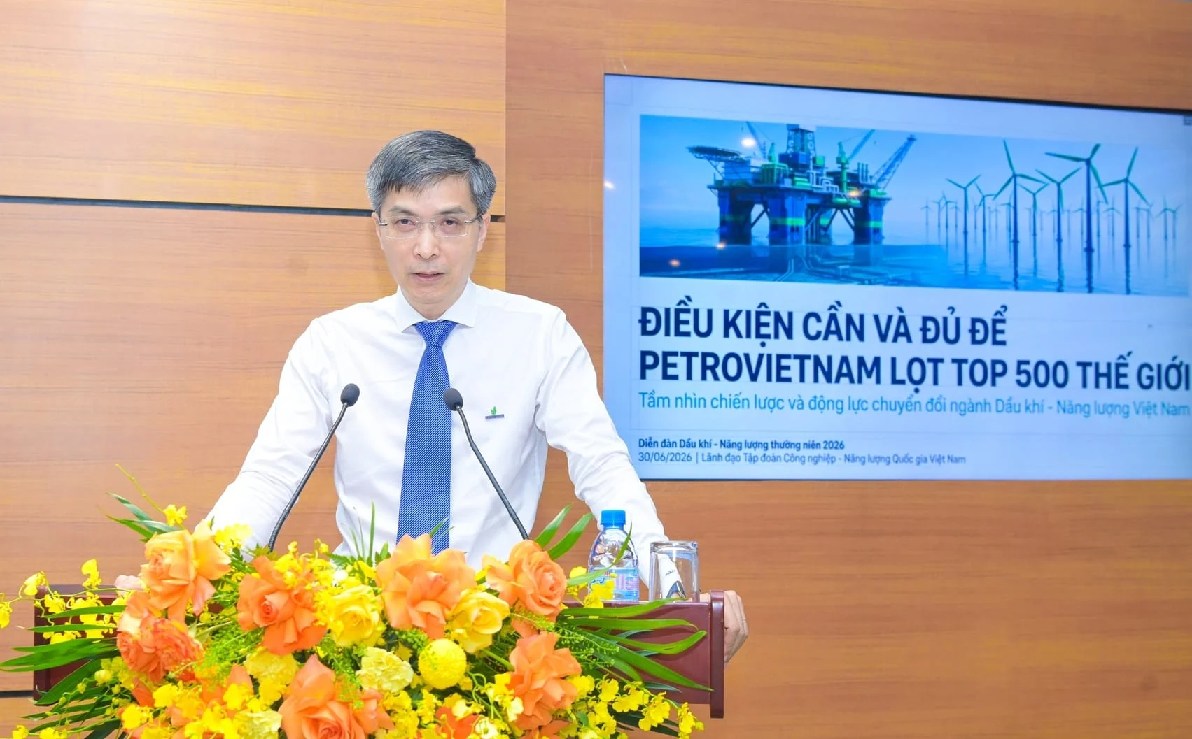
Mr. Vu Dao Minh, Deputy General Director of the Vietnam National Energy and Industry Corporation, stated that by 2030, the corporation aims to join the group of the world's top 500 enterprises and be among the top 10 leading energy and industry corporations in the region. Photo: Hong Tham .
The vision for 2050 is to continue maintaining its position among the top 500 companies in the world, leading the national energy transition, achieving consolidated revenue of $80-100 billion, ROA above 5%, supplying over 30% of the country's total final energy demand, of which over 50% is low-emission energy.
"This is a grand, ambitious goal, but it's not unrealistic. Petrovietnam has the historical foundation, industrial capacity, technical team, value chain, assets, market, and national role to achieve that goal. The challenge is to correctly identify the necessary and sufficient conditions to turn ambition into concrete results," the Petrovietnam leader emphasized.
A necessary condition is to innovate the growth model.
According to Mr. Minh, the necessary conditions are to innovate the growth model, improve core efficiency, and create new growth drivers.
First, Petrovietnam must maintain, strengthen, and improve the efficiency of its existing core operations. Oil and gas remain a crucial foundation of national energy security for decades to come. In the energy transition process, it cannot be achieved by weakening existing foundations, but must be based on a strong, efficient oil and gas industry capable of generating stable cash flow.
Therefore, Petrovietnam needs to continue focusing on improving the efficiency of oil and gas exploration and production; increasing reserves; optimizing the oil recovery factor; developing small and marginal fields; maximizing resource recovery; and reusing existing oil and gas infrastructure for new purposes such as CCS/CCUS, hydrogen, offshore wind power, and new energy sources. At the same time, it is necessary to improve the efficiency of the entire gas-electricity-fertilizer chain, refining, distribution, oil and gas technical services, offshore services, and supporting industries.
The second necessary condition is to accelerate the implementation of key projects. The goal of joining the Top 500 global companies cannot be achieved if major projects are behind schedule, over budget, or lack synchronization between different stages.

From its historical milestones to the present day, Petrovietnam continues to affirm its role as a pillar of the national energy sector – building the foundation for a prosperous and sustainable Vietnam. Photo: Pvn.vn.
The third necessary condition is the strong development of international business. A corporation aiming to be among the world's top 500 companies cannot rely solely on the domestic market. Petrovietnam needs to increase the proportion of revenue from international business, develop global trading capabilities, expand its presence in strategic markets, and participate more deeply in regional and global energy value chains.
The fourth necessary condition is that science and technology, innovation, and digital transformation must become genuine drivers of growth. In this new phase, Petrovietnam cannot compete solely on resources, capital, and infrastructure, but must compete on knowledge, technology, data, and innovation capabilities.
The fifth necessary condition is the development of eco-industrial and energy centers. This is a strategic direction that could create a turning point in Petrovietnam's growth model. Instead of implementing isolated, scattered projects lacking infrastructure connectivity and industrial synergy, Petrovietnam needs to shift to a model of integrated industrial, energy, logistics, and innovation centers.
The sixth necessary condition is innovation in governance implementation and the application and deployment of a roadmap to upgrade governance according to OECD standards. A correct strategy but insufficiently fast implementation will not produce results. Petrovietnam needs to operate its strategy through a portfolio of initiatives, with 14 key strategic initiatives including business initiatives and supporting platform initiatives: international E&P, international trade, gas/LNG value chain, downstream restructuring, offshore wind power, nuclear power, Petrovietnam restructuring, policy work, digital factory, M&A, strategic cooperation, talent development, financial transformation, and technology excellence program.
A sufficient condition is a favorable institutional, policy, and market environment.
According to Mr. Minh, if the necessary conditions lie in Petrovietnam's internal efforts, then the sufficient conditions are a favorable institutional, policy, and market environment for those efforts to be realized.
First and foremost, it is necessary to comprehensively improve the legal system regarding energy, oil and gas, electricity, industry, trade, and green transition. During the period 2026-2030, priority should be given to finalizing the revised Oil and Gas Law and its implementing decrees and circulars, aiming to remove obstacles to oil and gas exploration and exploitation; encouraging the development of small fields, marginal fields, fields with residual resources, deep-water and offshore areas; creating flexible mechanisms for resource recovery, improving recovery rates, sharing existing infrastructure, decommissioning fields, and reusing oil and gas infrastructure for new energy sources.
Secondly, a specific mechanism is needed for national strategic projects and project clusters. Eco-energy industrial centers, LNG-electricity-port infrastructure clusters, offshore wind power projects, hydrogen, CCUS, nuclear power, and green petrochemical projects are interdisciplinary and interregional projects with many component projects and multiple management agencies. Applying the same sequential procedures as for ordinary projects could prolong preparation time, leading to missed investment opportunities.
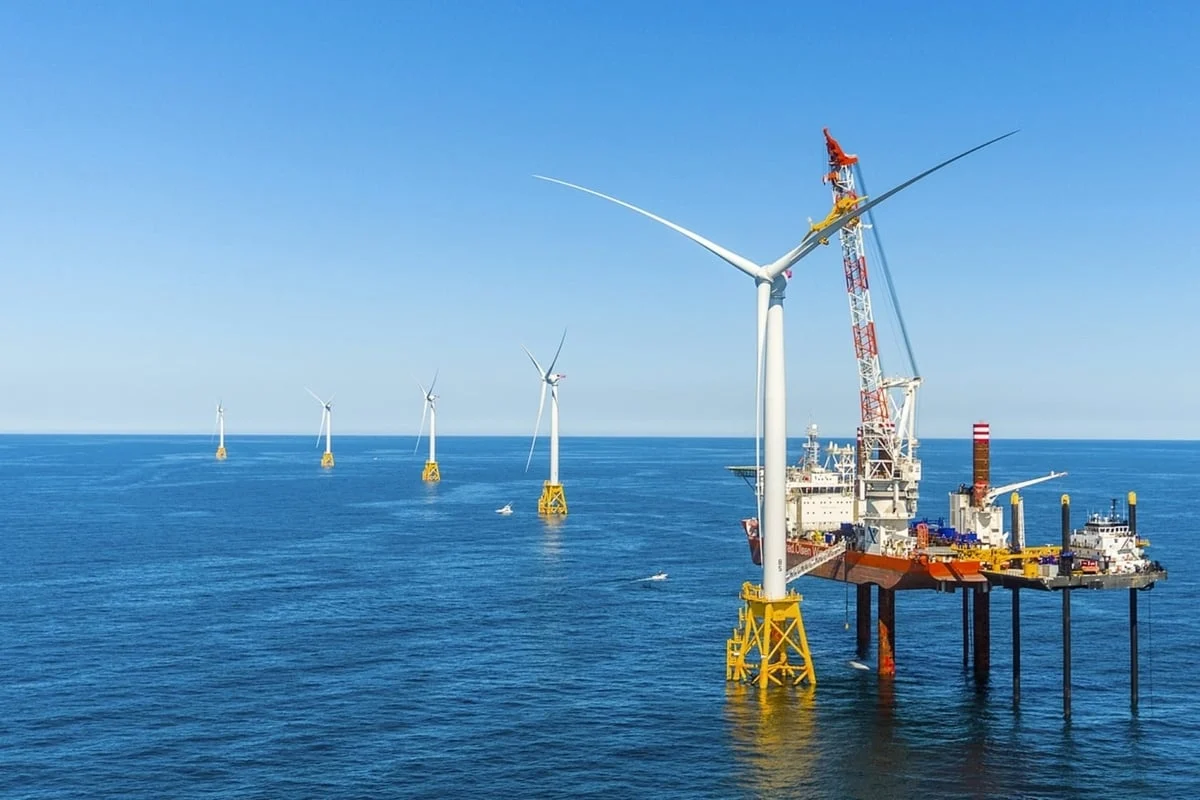
Petrovietnam is actively implementing its energy transition plan and roadmap with a focus on continuous and long-term execution. Photo: Pvn.vn.
Thirdly, it is necessary to establish Petrovietnam's role as the overall developer for large-scale industrial and energy centers. In this role, Petrovietnam can develop integrated planning, invest in shared infrastructure, coordinate project priorities, connect core and satellite investors, organize the operation of the industrial symbiosis ecosystem, ensure national interests, and optimize social resources.
Fourth, a sufficiently strong financial mechanism and decentralization of power are needed for state-owned enterprises in the energy sector. Petrovietnam aims to achieve a revenue scale of US$37 billion by 2030 and continue to grow thereafter, requiring a huge amount of investment capital. The enterprise needs to be more proactive in using after-tax profits, allocating funds for development investment, raising capital, issuing debt instruments, utilizing green finance, mixed finance, international syndicated loans, and M&A. At the same time, a stronger mechanism for decentralization and delegation of power to the Board of Members and the Executive Board is needed in investment decisions, cooperation, asset acquisition and sale, partner selection, and portfolio management, based on the principles of transparency, efficiency, and risk control.
Fifth, there is a need for mechanisms to encourage science and technology, innovation, and controlled experimentation. Fields such as AI, automation, energy storage, hydrogen, green ammonia, CCUS, clean fuels, new materials, industrial data, and digital transformation should be subject to a sandbox mechanism. A mechanism for accepting reasonable risks in research, testing, and commercialization of technology is necessary; innovation should not be evaluated solely based on the logic of "failure is unacceptable," but rather on process, objectives, data, compliance levels, and value created. Only then will businesses dare to invest in core technologies, new products, and future business models.
Sixth, a transparent, competitive, and long-term energy market needs to be developed. Energy businesses need a healthy competitive electricity market, an LNG market, a carbon market, a green credit mechanism, a green hydrogen/ammonia certification mechanism, an offshore wind power bidding mechanism, a long-term contract mechanism for low-carbon products, and ESG standards consistent with international practices. Stable and predictable policies are crucial for mobilizing large amounts of capital, especially international capital.
Mr. Vu Dao Minh, Deputy General Director of Petrovietnam, emphasized: "If the two necessary and sufficient conditions meet - Petrovietnam's self-renewal and the State's institutional development - then the goal of making Petrovietnam a leading industrial and energy group in the region, and ranking among the top 500 companies in the world, is not just an aspiration, but a task that can be achieved."
www.vietnam.vn