Potential to be among the world's 500 largest companies.
At the recently concluded 2026 Annual Oil and Gas - Energy Forum, Dr. Trinh Quoc Tuy, from the Central Policy and Strategy Committee, stated that Vietnam's energy sector is entering a profound transformation phase under the simultaneous impact of the global decarbonization trend, increasingly complex geopolitical shifts, and the need to ensure national energy security and self-reliance. In this context, repositioning the role of key state-owned enterprises in the energy sector has become an urgent requirement to meet the country's new development goals.
The year 2025 marks a significant turning point in development as the Vietnam Oil and Gas Group ( Petrovietnam) changes its name to the Vietnam National Energy and Industry Group (Petrovietnam ). This change reflects a strategic shift from a business model primarily focused on oil and gas resource exploitation to an integrated, multi-sector energy and industry group, playing a core role in ensuring national energy security, developing the energy industry, and promoting the green and sustainable energy transition.

Repositioning the role of key state-owned enterprises in the energy sector has become an urgent requirement to meet the country's new development goals. Photo: PVN
The foundation for this transformation is strengthened by Petrovietnam's growing scale and financial capacity. In 2025, Petrovietnam continued to record its highest-ever business performance. Consolidated total assets reached nearly 1.2 trillion VND; consolidated revenue exceeded 1.1 trillion VND, marking the fourth consecutive year of setting a new record and equivalent to approximately 9-10% of the country's GDP. Contributions to the state budget reached nearly 166 trillion VND, accounting for about 7-8% of total state budget revenue.
In particular, the value of implemented investments reached VND 51,400 billion, an increase of 44% compared to 2024, reflecting the determination to accelerate investment and development and prepare space for a new growth cycle associated with energy transition.
“At the long-term strategic level, Resolution No. 79-NQ/TW dated January 6, 2026, of the Politburo on the development of the state-owned economy has set a target that by 2030, at least 50 state-owned enterprises will be among the top 500 largest enterprises in Southeast Asia, and 1-3 Vietnamese enterprises will join the Fortune Global 500. With its asset size, revenue, and leading role in the energy sector, Petrovietnam is considered one of the enterprises with the greatest potential to realize this goal," Dr. Tuy added.
Sharing the same view, Associate Professor Dr. Ngo Tri Long from the Vietnam Financial Consulting Association stated that Vietnam has a huge need for energy investment. Petrovietnam and other businesses in the industry possess the capacity, experience, assets, workforce, and a special role in the economy. By 2025, Petrovietnam is expected to achieve total revenue of approximately 1,105 trillion VND, equivalent to 9-10% of GDP; and contribute nearly 166 trillion VND to the state budget. This is a crucial foundation for Petrovietnam to develop into a national industrial and energy group of regional stature.
The right mechanism is crucial, but Petrovietnam must also innovate itself.
According to Associate Professor Ngo Tri Long, in the new phase, Petrovietnam needs to be seen not only as an oil and gas corporation, but as a national industrial and energy corporation. This role requires Petrovietnam to both maintain its traditional oil and gas foundation and expand into new fields such as gas-electricity-LNG, deep refining and petrochemicals, high-quality technical services, offshore energy, carbon storage, hydrogen, green ammonia, and low-emission energy solutions.
However, to fulfill that role, Associate Professor Dr. Ngo Tri Long believes that "Petrovietnam needs a sufficiently broad institutional space." A business tasked with ensuring the major balances of the economy cannot operate with mechanisms that are too tight at the input stage, too slow in approval processes, too short-term in performance evaluation, and too restrictive in capital mobilization.
Petrovietnam needs to be given more autonomy in investment, international cooperation, portfolio management, capital utilization, debt issuance, establishment of specialized investment funds, participation in the carbon market, and implementation of risk hedging tools. This empowerment should be accompanied by modern oversight: transparent objectives, standardized reporting, independent audits, portfolio-based evaluation, and a clear separation of business and policy objectives.
“Petrovietnam can play a leading role in large-scale projects, attracting international capital, linking with banks, investment funds, development finance institutions, technology companies, and strategic partners. But that role can only be fully realized when market mechanisms and financial mechanisms are designed in a synchronized manner,” Associate Professor Ngo Tri Long emphasized.
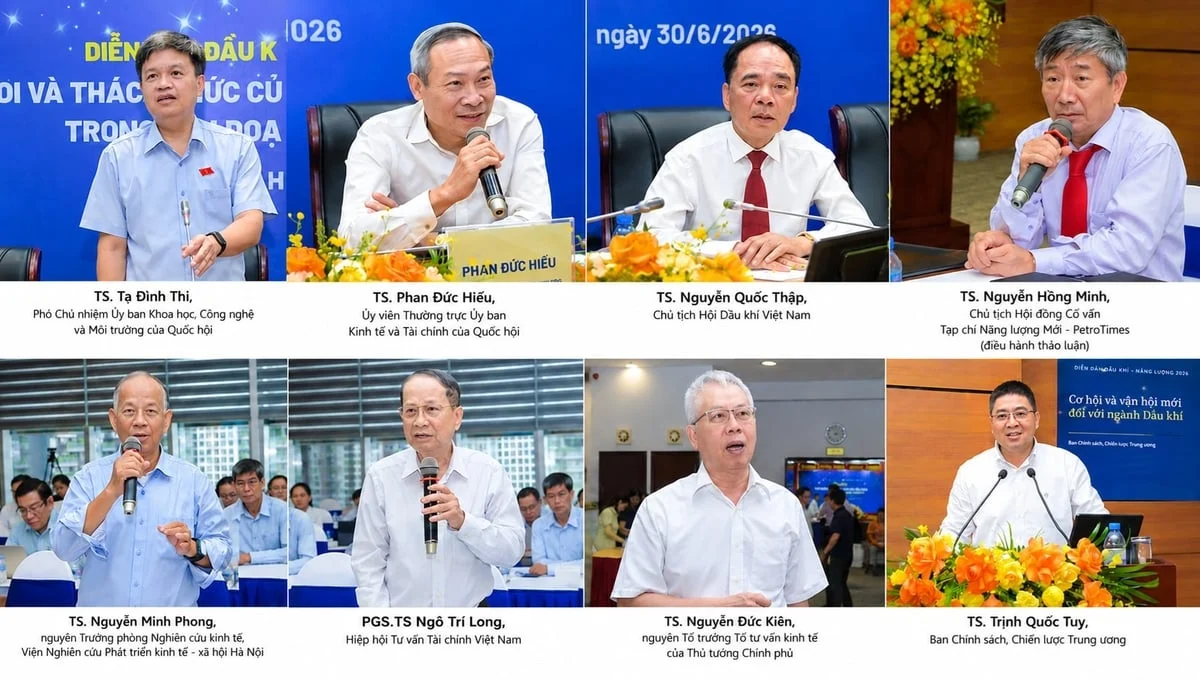
Managers and experts attending the Forum analyzed the context, pointed out institutional, mechanism, and governance bottlenecks, and proposed numerous solutions to create new momentum for the development of the oil and gas - energy sector and Petrovietnam in the coming period. Photo: Hong Tham.
Dr. Nguyen Minh Phong, former Head of the Economic Research Department at the Hanoi Institute for Economic and Social Development Research, proposed developing a national energy ecosystem where the coal, electricity, and oil and gas industries are closely interconnected for mutual benefit; and establishing a national energy security fund (including both financial and material resources).
Meanwhile, Dr. Nguyen Duc Kien, former head of the Prime Minister's Economic Advisory Group, proposed including offshore wind power in the revised Oil and Gas Law; and strongly promoting decentralization and delegation of power to the Ministry of Industry and Trade and Petrovietnam to shorten the decision-making process and create a robust mechanism for oil and gas-energy projects.
Meanwhile, Dr. Phan Duc Hieu, Standing Member of the National Assembly's Economic and Financial Committee, believes that offshore wind power should be defined in either the Oil and Gas Law or the Electricity Law, instead of creating a separate law for this sector.
According to Dr. Ta Dinh Thi, Vice Chairman of the National Assembly's Committee on Science, Technology and Environment, Petrovietnam needs to continue optimizing its value chain and leveraging its superior advantages in the marine economy to expand into marine energy sectors, especially offshore wind power. Revising the Oil and Gas Law in a way that promotes innovation will create new development opportunities, helping Petrovietnam enhance its competitiveness and play the role of a national industrial and energy corporation in the coming period.
Dr. Nguyen Quoc Thap, Chairman of the Vietnam Petroleum Association, emphasized that Petrovietnam, formerly a national oil and gas corporation, is entering a new position: the Vietnam National Energy Industry Corporation. This is not just a change in name; it represents an expansion of vision, operational scope, and development responsibilities.
Petrovietnam is not only involved in oil and gas exploration and production, but is also operating an entire ecosystem: upstream, gas industry, electricity, petrochemicals, fertilizers, high-tech services, energy trading, and new energy directions. If viewed correctly, Petrovietnam is not just a large enterprise. Petrovietnam is a strategic capacity of the State in ensuring energy security, economic security, maritime security, and in the energy transition process.
"But it must also be made clear: A grand positioning must be accompanied by grand capabilities. Appropriate policy mechanisms are crucial, but Petrovietnam must also strongly innovate from within. This means more modern governance, faster decision-making speed, higher implementation discipline, better financial and market capabilities, stronger new technology workforce, and more professional risk management," Dr. Thap emphasized.
According to Dr. Trinh Quoc Tuy, from the Central Policy and Strategy Board, in order to realize the goal of becoming a regional-scale enterprise and eventually joining the Fortune Global 500 group, Petrovietnam needs to focus on several major directions such as:
- Continue to refine the governance model according to advanced OECD standards and international practices.
vietnam.vn/en