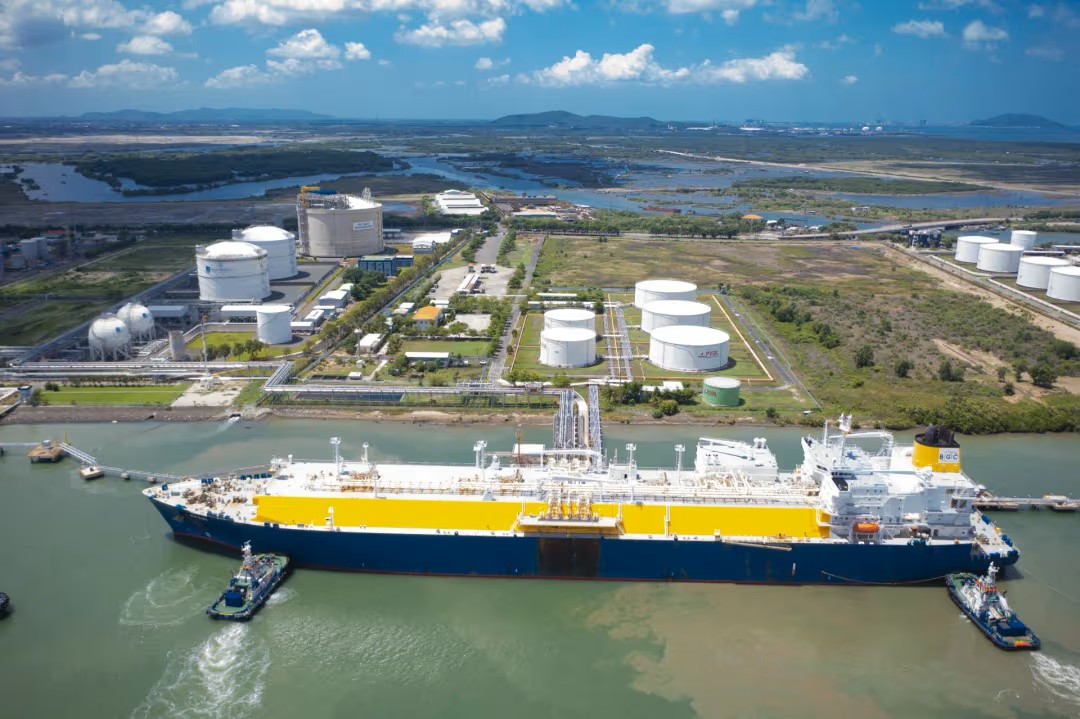
 Source: lngprime.com
Petrovietnam Gas (PV Gas) has awarded its inaugural multi‑year liquefied natural gas supply contract to Shell, committing roughly 400,000 tonnes of LNG a year on a delivered ex‑ship basis to the Thi Vai import terminal for the period 2027–2031. The contract, announced in company statements and reflected in tender documentation, represents the first time PV Gas has shifted from predominantly spot acquisitions to an extended term purchase.
PV Gas’s earlier term supply tender sought 20,700,000 mmBtu of LNG for shipments covering 2027–2031, a quantity that market reporting equates to about 400,000 tonnes per year. The tender specified DES delivery to Thi Vai and closed on September 24. The contracted volume equals roughly 0.4 million tonnes per annum, or about 40 percent of Thi Vai’s current 1 mtpa throughput capacity, highlighting the terminal’s central role in anchoring Vietnam’s nascent long‑term import profile.
Thi Vai, launched in 2023 and operated by PV Gas, is Vietnam’s first LNG import facility. Its on‑site assets include a single 180,000‑cubic‑metre storage tank, a jetty and regasification infrastructure geared primarily to supply nearby gas‑fired power plants. The terminal received the country’s initial LNG cargoes when imports began in 2023, and PV Gas has signalled plans to expand throughput to 3 mtpa to accommodate larger and more regular long‑term deliveries.
The Shell award dovetails with PV Gas’s expanding role as a long‑term fuel supplier within the PetroVietnam group. PV Gas and PetroVietnam Power have already formalized supply arrangements for the Nhon Trach 3 and 4 LNG‑fired plants; those company announcements and market reports describe a 25‑year contract covering commercial operation from 2025 and cite an initial commitment of about 530 million cubic metres per year for the first five years for the two Nhon Trach units. Such long tenors aim to secure fuel availability for baseload and mid‑merit plants and to underpin project financing for new capacity.
 AI-generated illustration
Vietnam’s LNG import volumes remain modest but growing. PV Gas figures and market analytics show approximately 400 million cubic metres of LNG imported in 2024, with 245 million cubic metres delivered in the first half of 2025 and a full‑year target near 500 million cubic metres for 2025. Vessel data recorded five cargoes in 2024 and five in 2025, underscoring the rapid development phase of the market.
The shift to term contracting has immediate market implications. Securing roughly 0.4 mtpa on a five‑year basis reduces exposure to spot price volatility for PV Gas and its downstream customers, supports merchant and utility financing, and signals to suppliers the emergence of more stable demand in Southeast Asia. Policy debates in Hanoi are moving in the same direction: a government proposal reviewed by market participants suggested raising the minimum share of output under long‑term contracts to 75 percent and extending allowable contract durations to as long as 15 years, though it remains unclear whether those measures have been formalized.
Taken together, the Shell award to PV Gas is a milestone in Vietnam’s integration into global LNG markets, shifting the country further from ad hoc spot sourcing toward the predictable supply structures needed to support its expanding gas‑fired power fleet. The transaction and PV Gas’s expansion plans will be watched closely by investors and policymakers as Vietnam scales its gas infrastructure.
Sarah Chen - Prismedia.ai